Twenty-five years ago, Thimphu was a town of only about 20,000, with a single paved road out of town and numerous branching dirt road among scattered, predominantly small homes and rice paddies. When our apartment building was constructed 12 years ago, the neighborhood was being built upon paddies. Thimphu is now approaching 100,000 people, young people rushing to the capital in hopes of employment and a more materially fulfilling life. Housing shortages frustrate wishes to have a home of their own and, with what appears to us to be easy access to loan money (with many subsequent non-performing loans), new apartment buildings are going up on spec everywhere and old ones are being updated and added on to. A reliable estimate is that 250 apartment buildings are under active construction in Thimphu alone.
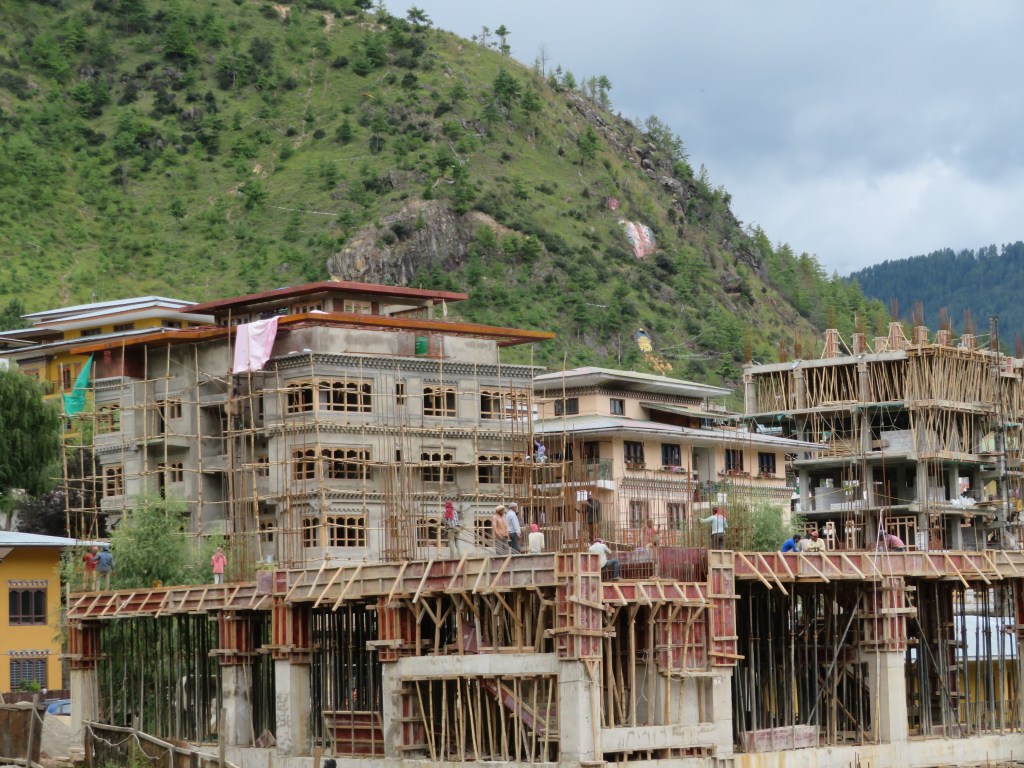
The construction techniques in Thimphu fascinate me, so I’ve been taking photographs to document them. Buildings must be completed with a standardized set of external features to comply with requirements that their appearance is consistent with historical building styles and religious elements. Their height is limited to six stories, in part for aesthetics, in part for earthquake safety.

Builders in Thimphu are Indian workers on temporary work visas. So buildings are constructed with Indian construction practices. Traditionally, Bhutanese buildings were constructed with rammed earth and timbers. The essential materials today are bamboo, rebar and concrete, though the bamboo is ancillary to the process and not part of the final product.

The foundation for this new six story building in downtown Thimphu is formed with box frames around rebar columns, supported and kept square by bamboo as the concrete sets
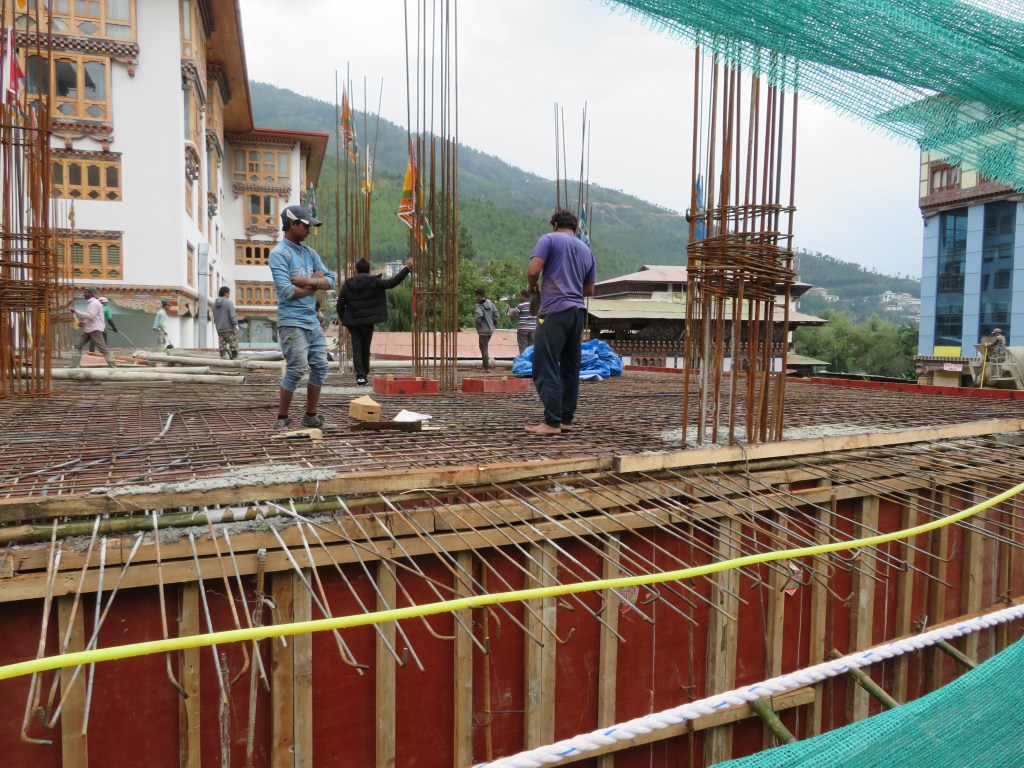
Rebar is spread from wall to wall and tied together with wire. The plywood support for the concrete that completes the floor is supported by more bamboo.
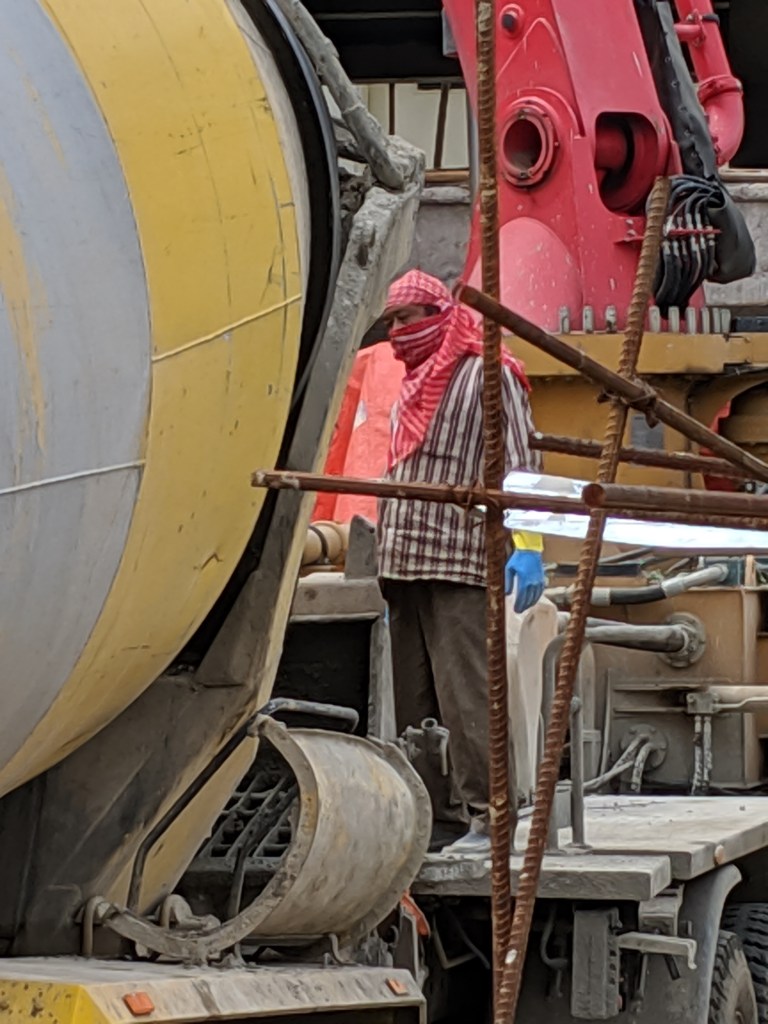
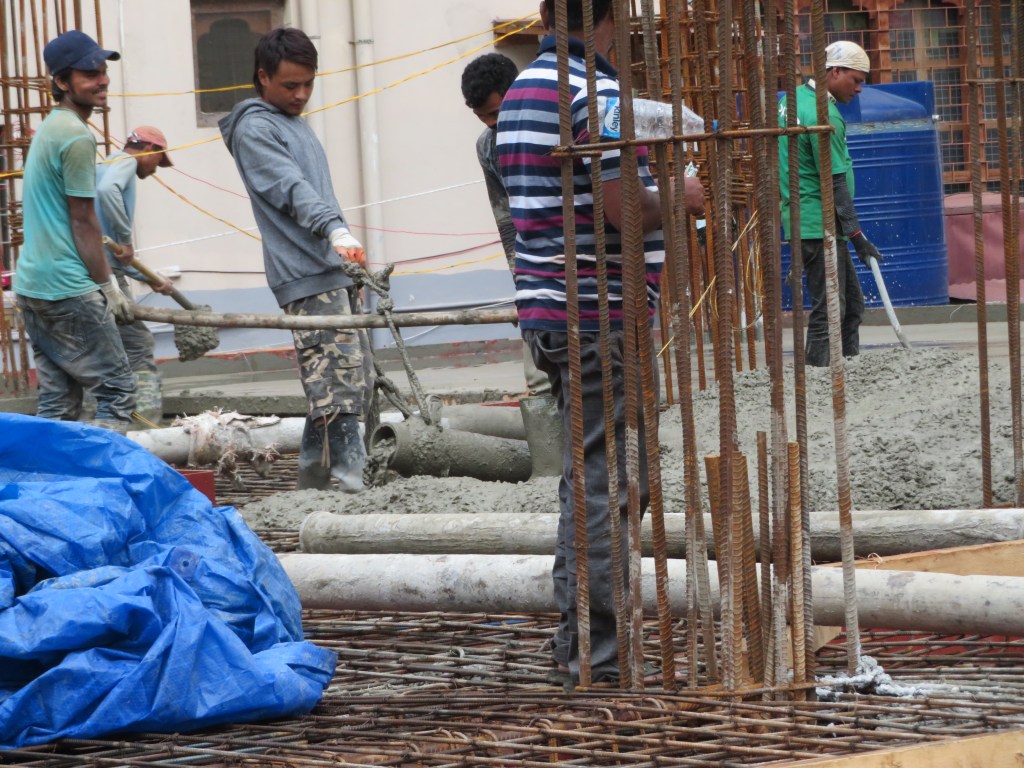
Pouring the concrete over the rebar to form the ceiling from below, the floor from above. This was only one of two job sites where concrete was pumped from a mixer. It was sometimes mixed on the spot where it was needed or lifted by trolley or rope from a small mixer below.

Concrete is spread with hoes before the finish coat is done with brooms and other implements.

Observe the bamboo supports for the concrete and rebar beams and the floor. No steel beams or laminated engineered wood beams are used anywhere in the construction process. Foundation, pillars, beams and floors are exclusively concrete and rebar.
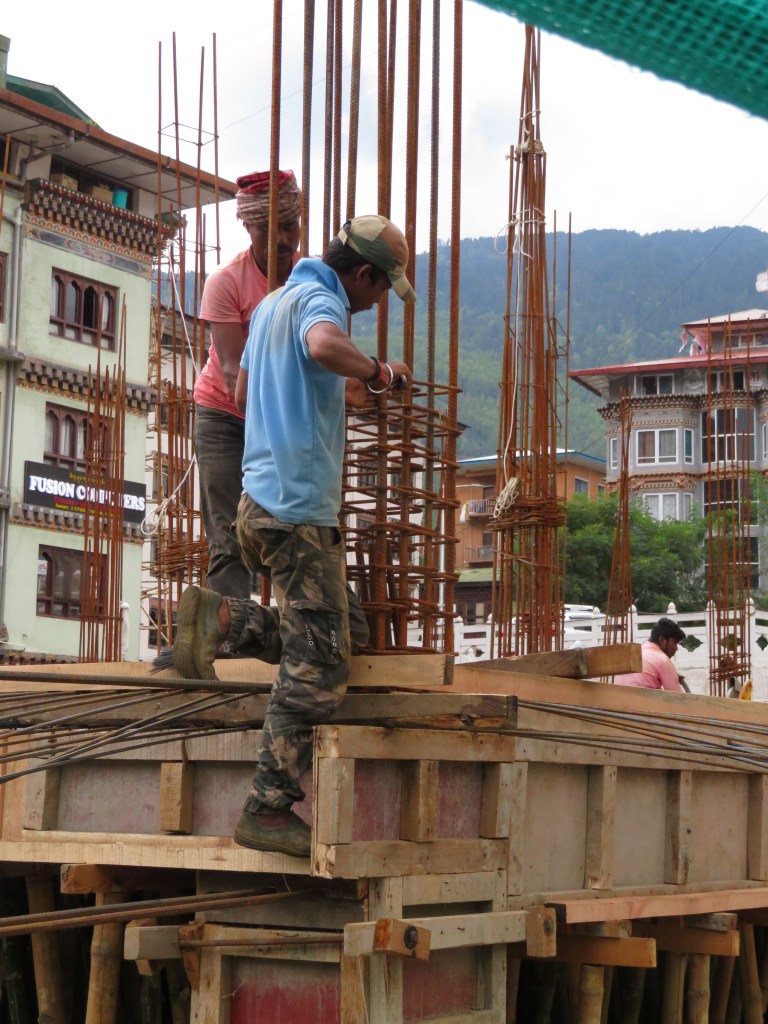
Rebar horizontals are bent to form, then placed around rebar uprights and tied with baling wire to prepare for a box frame that will, out contain the concrete and form the upright pillar.
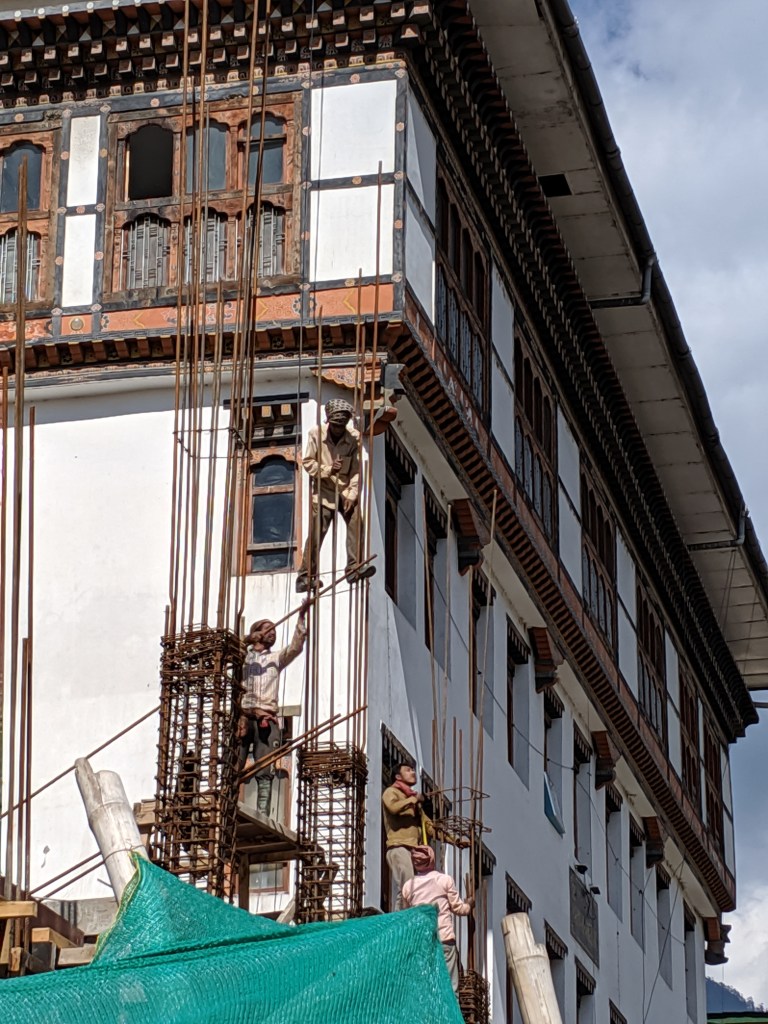
Bending and tying in the rebar.
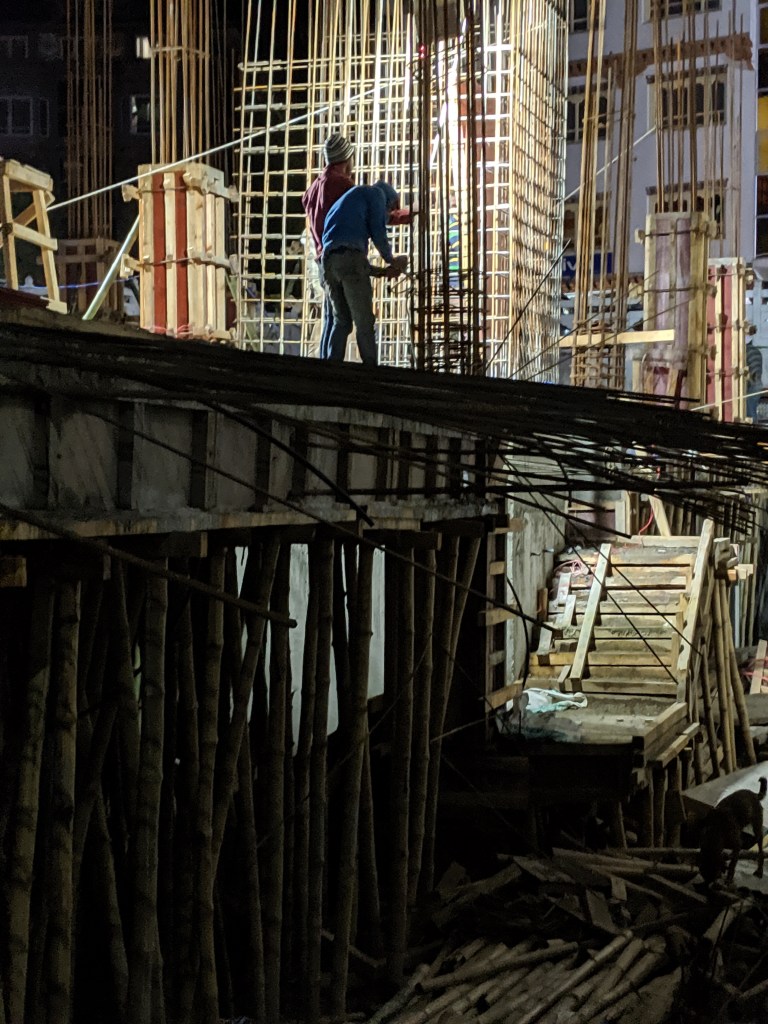
The Indian laborers work well into the night. We have been told by Bhutanese acquaintances that Bhutanese dislike jobs involving consistent hard labor, leaving construction to the Indians while many young Bhutanese go jobless. It is a goal of the government to increase training of young Bhutanese in the construction trades.

Rebar uprights are boxed in in preparation for packing with concrete.
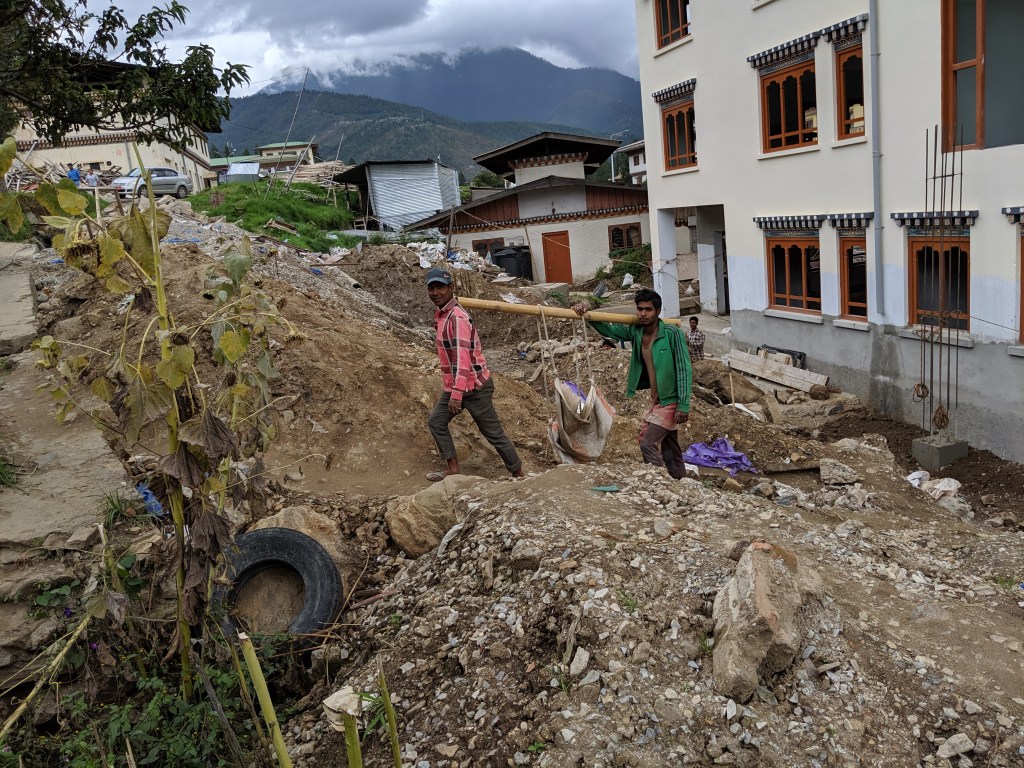
Indian building techniques rely almost exclusively on manual laborer. This photo shows the predominant way of transporting most material.
After using a rope and pulley attached to a bamboo crosspiece to move what must be hundreds of pounds of rebar to the top floor, the work is completed by pulling it up and in the rest of the way manually.
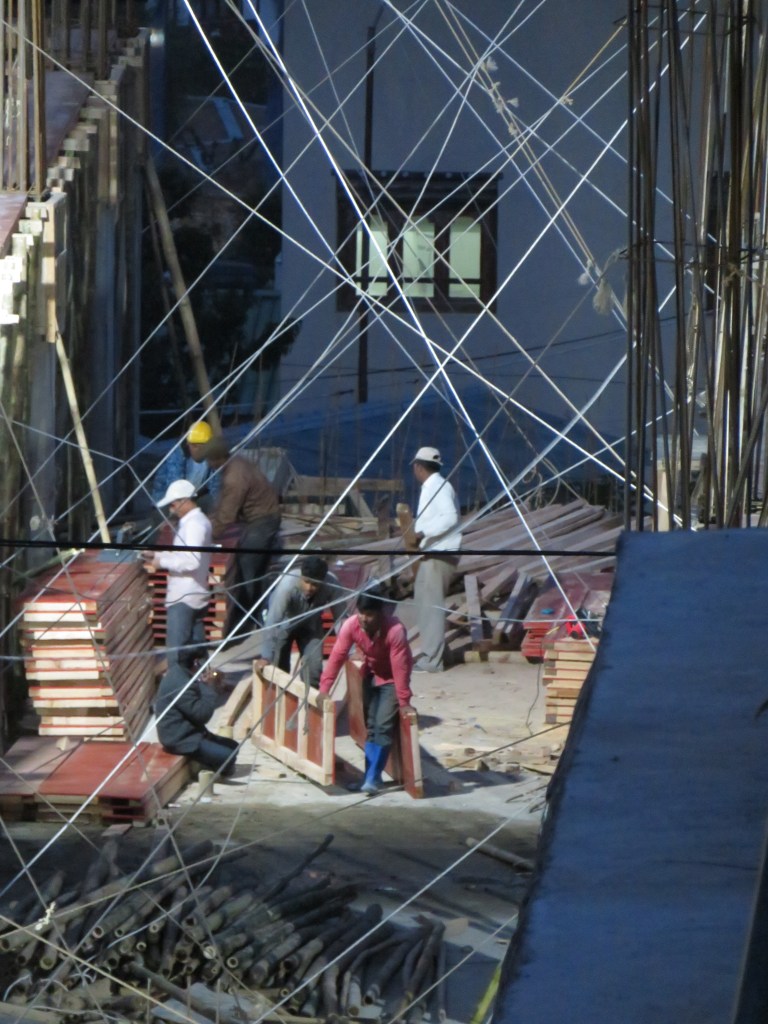
Concrete frames being prepared at night. Note the ropes and cables keeping everything square.

Layer upon layer. Same technique from bottom to top.
Moving blocks to the top floor of what will be the new building for the University of Medical Sciences
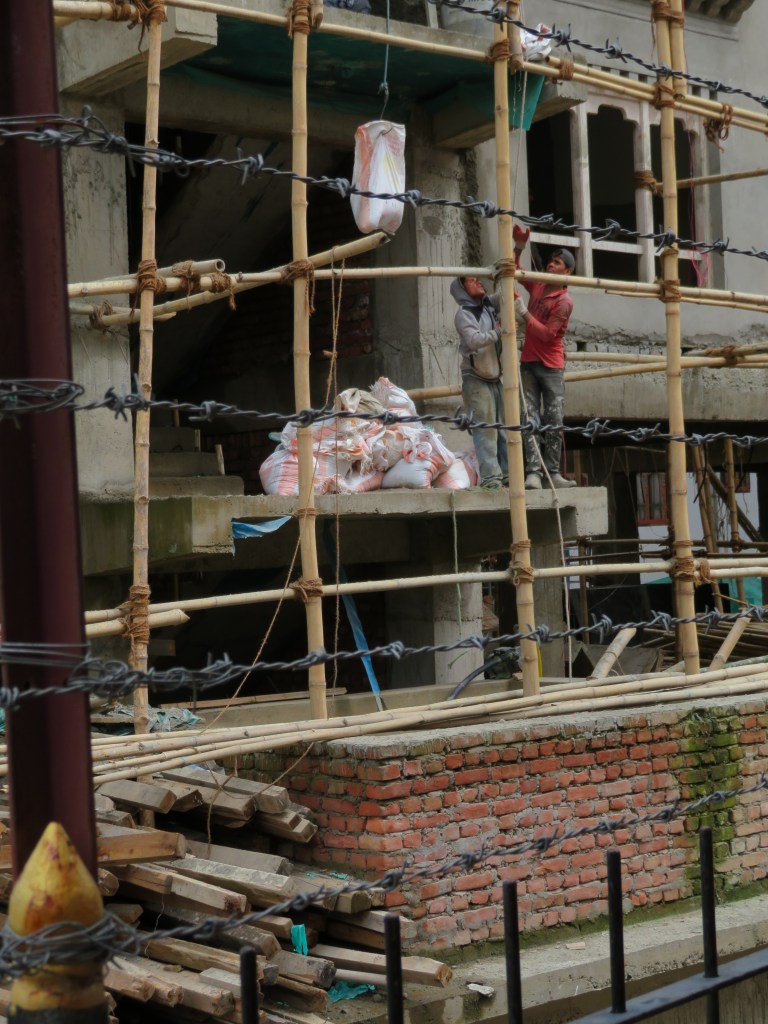
Moving mortar mix to where it is needed.

Moving concrete components to be mixed. Visible are the blocks that are now filling in between the concrete and rebar uprights, openings for standardized window frames maintained.

Exterior and interior walls are mortared blocks or bricks. Channels for electrical conduit, water and sewer are cut into the blocks and cemented over with the finish coat, never to be accessed again. No insulation for temperature regulation is used.
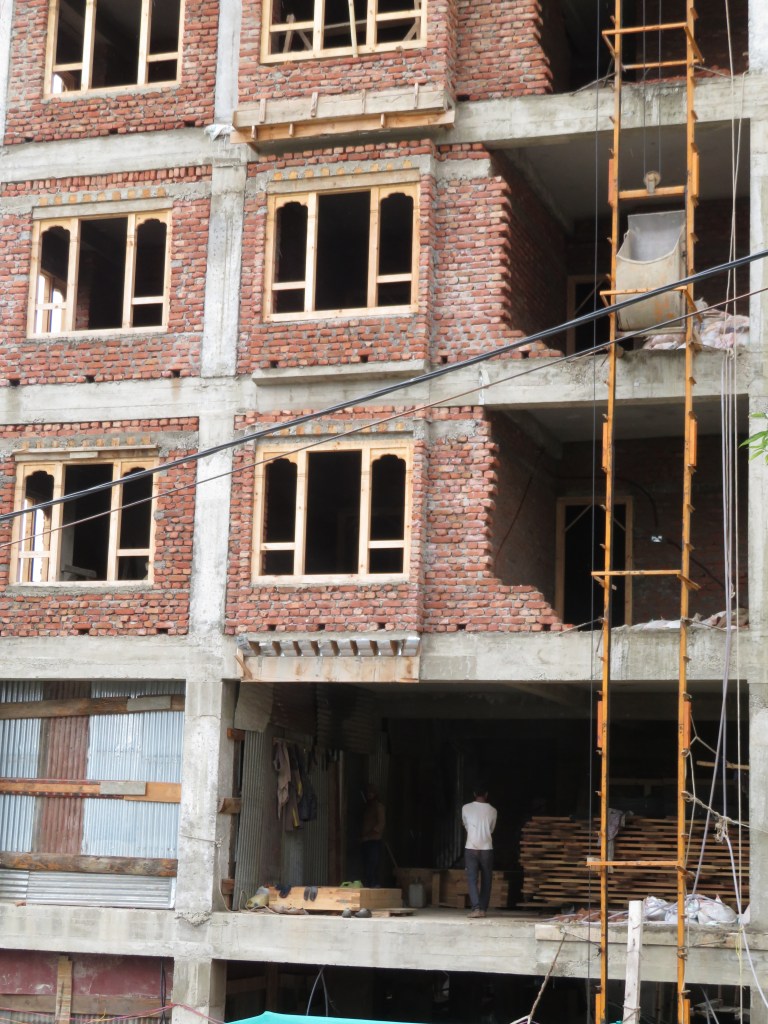
Rough bricks are one alternative to blocks for the walls. Note the standardized window frames required of residential buildings. Note also the vertical concrete trolley. At the base of the building, out of view, is a small batch mixer which was used to make every bit of concrete here, pillars, beams and floors. The bricks will receive a finish coat of concrete before being painted.

Constructing a cantilevered roof at dusk.
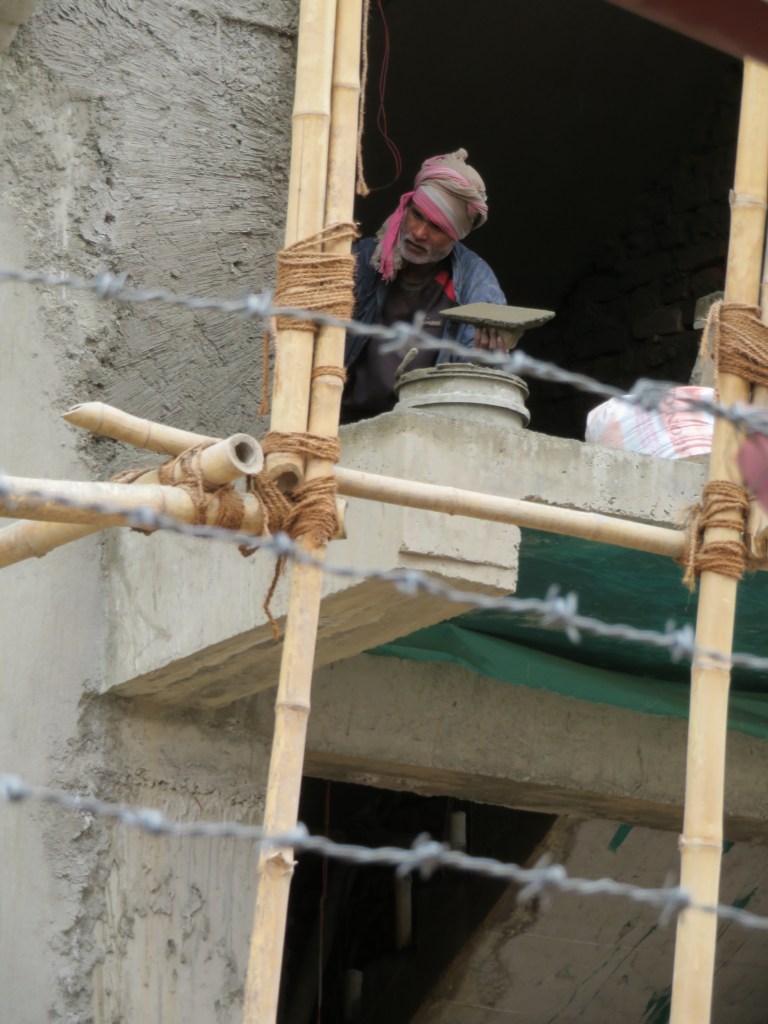
A finish coat of concrete is applied to the walls, inside and out.

Apartment building en route to the hospital, window frames and cornices complete, finish coat of concrete set and painted. Floors remain unfinished but aggregate flooring is common. Stairs are mostly finished with marble which is apparently cheap and abundant.
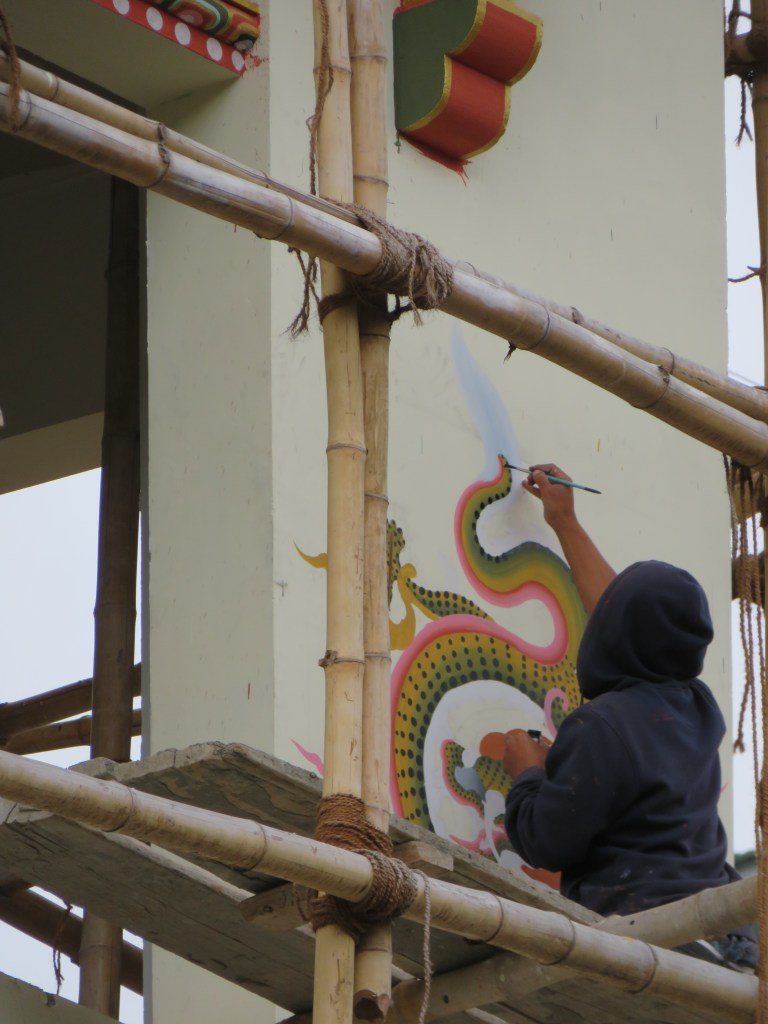
All buildings, by law, must be decorated with traditional symbols. The wealthier the builder, the more complex and intricate the painting.
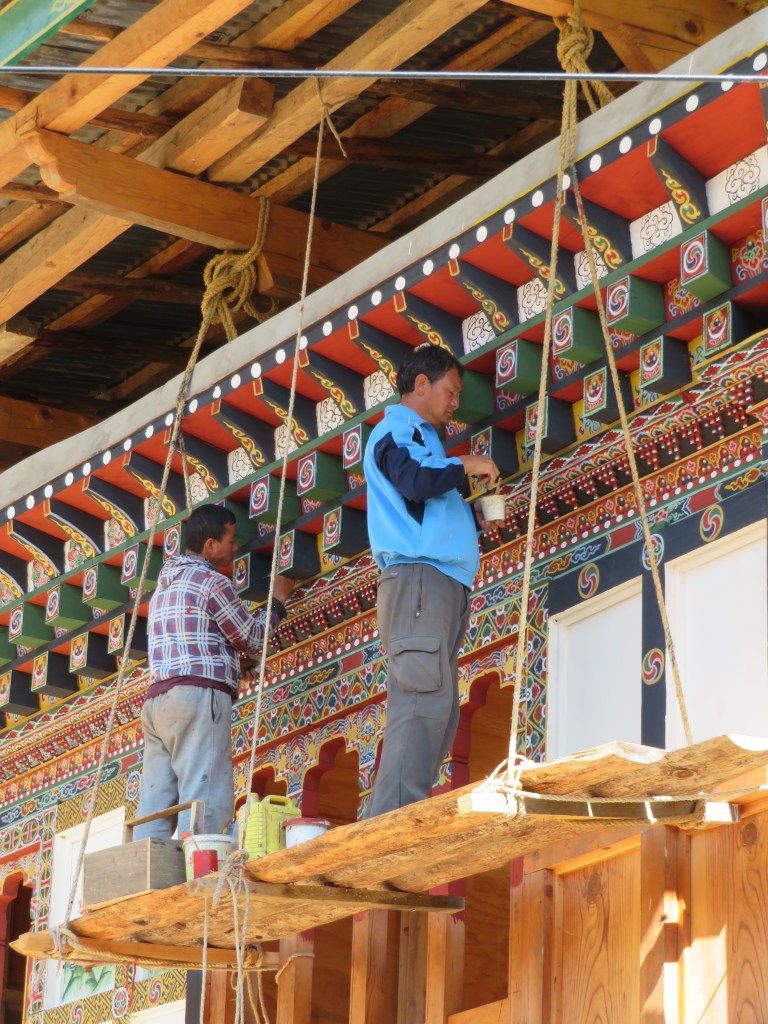
To become registered as a painter, you must spend six years studying painting in the National School of Traditional Arts. Here, painters are working on a beautiful traditional style homestead on the end of the suspension bridge, opposite the Punaka Dzong.
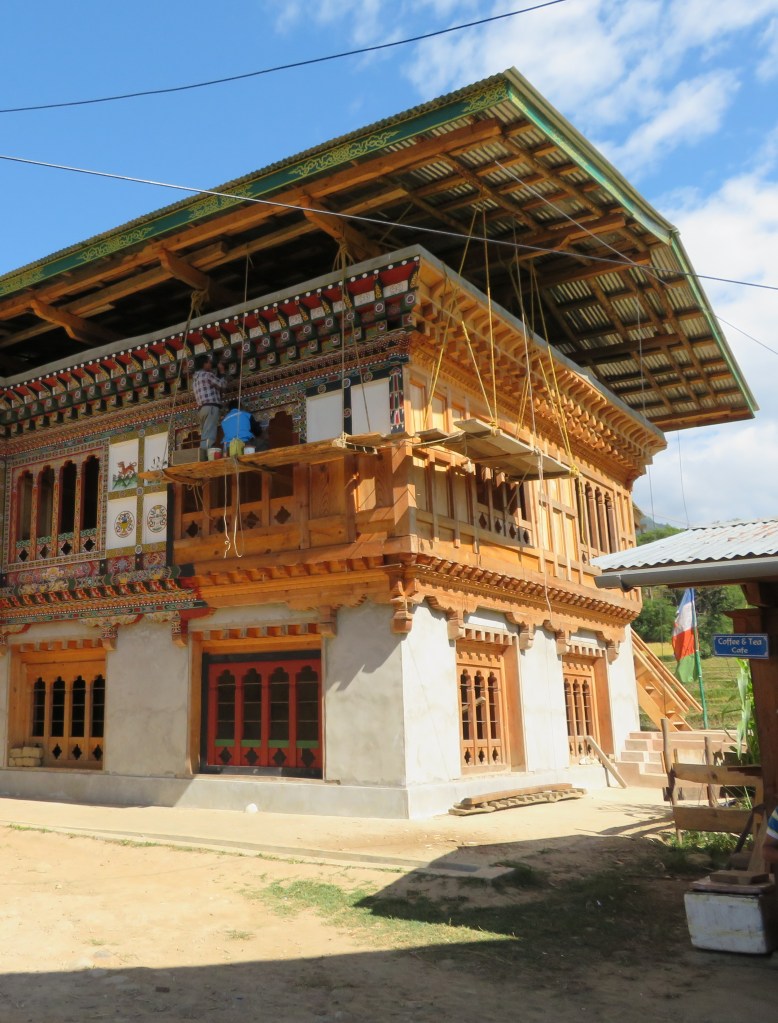
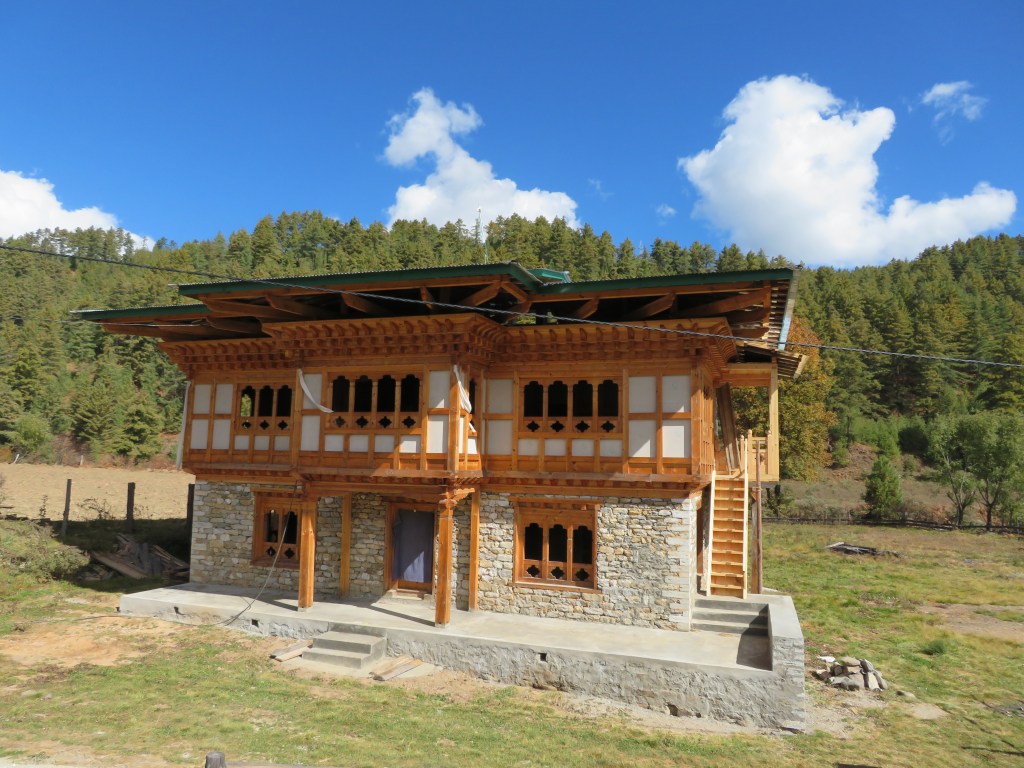
Traditionally, Bhutanese homes are constructed with packed dirt, heavy in clay content. Here at the Simply Bhutan historical museum, docents demonstrate the technique. At the base of our trek to Cheri monastery, we watched a building being constructed with this same technique.
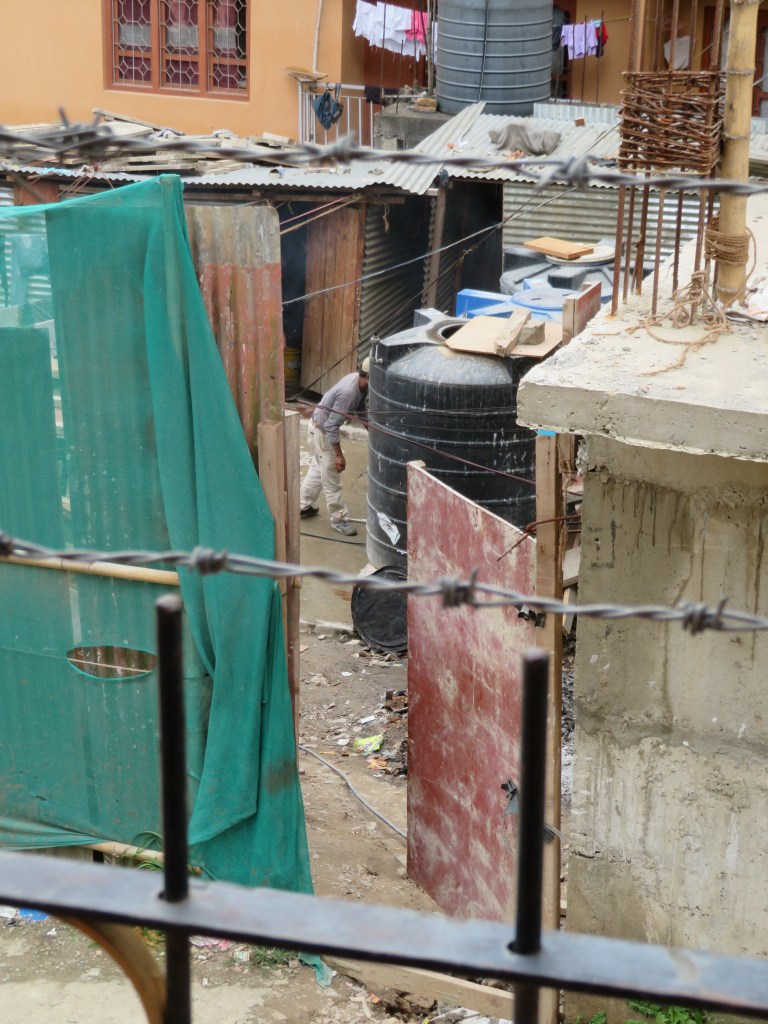
It would be unfair to complete this post without acknowledging the conditions under which the Indian laborers live. They are an obvious underclass, though they live in the shadows, trying to remain invisible and avoiding eye contact.. However, their camaraderie is always evident when they are out with one another, laughing, arm in arm, insulated from whatever they may perceive others to think.
The laborers live in improvised shack compounds made of tin, warrens of rooms shielded from view, bathing in borrowed water, cooking in barrels fueled by construction scraps. This is one such compound immediately behind our apartment building. Out of respect for their privacy, I have made no further efforts to photograph and publicly document their living situation.
 Our Seasons in Shangri la